Wednesday, 18 June 2014
Private View of my exhibition
Last night at 6 O'clock the doors to the exhibition opennnnnneddd! It was a brilliant night and it was so nice to finally see everyones finished work. I was so very proud of everyone for doing such an amazing job, i was immensely proud to be a part of it. I didn't managed to talk to many people about my own work as i was very busy showing my parents around at others and also getting the chance to look at all the exciting work around. Hoverer, i did over hear a few people talking about my work and it was very warming to hear their reactions, which were much more positive than i could have imagined. One persons comments struck a chord more than any other though. Pete Float, the 3D tutor for our foundation group came to me and congratulated me on my work and he has enjoyed very much seeing its creation and development. This coming from him, whom i haven't had many chances to talk with, made me feel very happy. My parents reactions to show also surprised me, although my dad didn't say too much about my work i could tell they were immensely proud of my work and they also enjoyed looking at all the wonderful creations my peers had made.
Final piece progress.
As it is now coming to the end of my Foudation year and our exhibition is now open I thought now would be the time to share the progression shots of my final peice and its final outcome.
Sunday, 25 May 2014
Mother, MOTHER
CANVAS TIME!!!!
Saturday, 3 May 2014
Charity football match for Diabetes UK
Last Sunday was game day, and we had such a great turn out from both the participating players and also spectators. Each player gave a donation of £5 to play and all money made at the bar also went to the charity. Although I was extremely out of shape and came close to cardiac arrest it was a very fun filled and exciting day. My team won 8-2.
Just yesterday it was posted up at work that we had in fact raised just over £370! This was fantastic, and i was very proud to have taken part. Because of how well it all went it has been decided that yet another charity match is going to happen, this time against West-Durrington Tesco rather than ourselves. I don't think i have been asked to join in with the actual playing this time as a strong team has been chosen (we need to beat West-Durrington) but i am definitely going to watch, and donate :)
Saturday, 18 January 2014
Booth Museum of Natural History
'Inner life of objects'- Jan Svakmajer
On the 18th November 2013 i went to Brighton to see Jan Svankmajers 'inner life of objects' exhibition at the Brighton university gallery. Here i saw samples of Svankmajers incredible 50 year career, from his Imaginary creations in his encyclopedia to the sets and creations from his films such as Alice. I also got the chance to watch snippets of some of his films and a large part of Alice, in which a swimming rat started to make dinner upon the gold locks of the little girl.
This exhibition was surreal. It allowed me to see up close the work of Svankmajer that i before had only seen behind a screen, it was such a pleasure. The works he created were so life like although made out of complete imagination and impossibilities. Out of everything at the exhibitoon there was one thing that hit home for me and made me start thinking in a totally new light. This was Jan Svankmajers Decalogue. I have taken the points in his Decalogue and have and continue to use for myself in life and in my own practice.
The points of the Decalogue read:
3. Use animation as a magical operation. Animation isn’t about making inanimate objects move, it is about bringing them to life. Before you bring an object to life, try to understand it first. Not its utilitarian function, but its inner life. Objects, especially the old ones, were witnesses to certain happenings, people’s actions, their fortunes, which somehow marked them. People touched them in different situations, while acting under various emotions, and they imprinted onto them these different mental states. If you want to disclose some of these hidden aspects of objects through your camera, you need to listen. Sometimes even for years. First you have to become a collector, and only then a filmmaker. Bringing objects to life through animation has to be a natural process. Life has to come from within them, and not from your whim. Never violate objects! Don’t tell through them your own stories, tell theirs.
5. If you are trying to decide what is more important trust the experience of the eye or the experience of the body; always trust the body, because touch is an older sense than sight and its experience is more fundamental. Apart from that, in our contemporary audiovisual civilization, the eye is rather tired and ‘spoilt’. The experience of the body is more authentic, uninhabited by aestheticisation. But be aware of synaesthesis.
7. Imagination is subversive, because it puts the possible against the real. That’s why you should always use your wildest imagination. Imagination is the biggest gift humanity has received. Imagination makes people human, not work. Imagination, imagination, imagination...
The points of the Decalogue read:
1. Remember there is only one form of ‘poetry’. The opposite of poetry is professional expertise. Before you start making a film, write a poem, paint a picture, create a collage, write a novel, essay etc. Only by cultivating your ability for universal expression will you ensure you will produce a good film.
2. Surrender to your obsessions. There is nothing better. Obsessions are the relics of childhood. And the most precious treasures come from the depths of childhood. You need to always keep the gate to your childhood open. It is not about specific memories, it’s about feelings. It’s not about consciousness, it’s about unconsciousness. Let the inner river flow freely through you. Concentrate on it but at the same time relax completely. When making your film, you need to be 24 hours submerged ‘in it’. Only then will all your obsessions, your childhood, enter your film, without you being consciously aware of it. And your film will become the triumph of ‘infantilism’. And that is what it’s all about.
4. Keep exchanging dreams for reality and vice versa. There are no logical transitions. There is only one tiny physical act that separates dreams from reality: opening or closing of your eyes. In daydreaming even that isn’t necessary.
6. The deeper you enter into the fantastic story the more realistic you need to be in the detail. At that point you need fully to rely on your experience of dreams. Don’t worry about being ‘boringly descriptive’, pedantically obsessive about an ‘unimportant detail’, documentaristic. You need to convince the viewers that everything they are seeing in your film concerns them, that it is a part of their world too, and they are submerged in it to their ears, without realising it. You need to convince them about that, through all the tricks you possess.
8. Always pick themes that you feel ambivalent about. This ambivalence has to be strong (deep) enough so you can walk on its edge and not fall to either side or even both at the same time. Only by doing that will you be able to avoid the biggest sin: film à la these.
9. Cultivate your creativity as a form of self-therapy. Such an anti-aesthetic attitude brings creativity closer towards the gates to freedom. If there is any purpose at all in creativity it is that it liberates us. No film (painting, poem) can liberate a viewer unless it didn’t liberate its author first. Everything else is a question of ‘common subjectivity’. Creativity as a process of permanently liberating people.
10. Always put the continuity of your inner vision or psychological automatism before an idea. An idea, even the greatest one, shouldn’t ever be a sole motivation for wanting to make a film. The creative process doesn’t mean stumbling from one idea to the next. An idea becomes a part of a creative process only when you have found the theme that you want to express and you fully understand it. Only then will the right ideas emerge. An idea is a part of creative process, not an impulse for suddenly becoming creative. Never work, always improvise. Script is important for a producer, not for you. It’s a non-binding document you should only return to when your imagination lets you down.
Although I have formulated this Decalogue on paper it doesn’t mean I consciously refer to it. These rules somehow emerged through my work, they didn’t precede it. Anyway, all the rules are there to be broken (not avoided). But there is one rule which, if broken (or even avoided), becomes destructive to the artist: Never subordinate your personal creativity to anything but freedom.
| My drawing of Svankmajers puppet from 'Little Otik' 2000 |
![]() |
| Pages from my sketchbook. I was inspired by Svankmajers Exhibition to create my own make belief animal. |
A day out in London: Flipagram video
A few days ago I downloaded Flipagram on my iPhone. Flipagram is an app in which you can put together a series of photos to collectively make a slideshow or miniature film. What I like about the app is that you can too add music of your own choice, choose where the film starts in respect to your music and also how long each photo is shown for. On downloading this from the app store I thought it a good idea to put together a film of a couple of my days out, one of which my day out in London. So... here it is. Sorry about the quality, it didn't transfer from phone to computer very well. The video shows Topshop, Hamleys, and the Apollo Victoria Theatre where I saw Wicked the musical.
Sunday, 8 December 2013
London Topshop
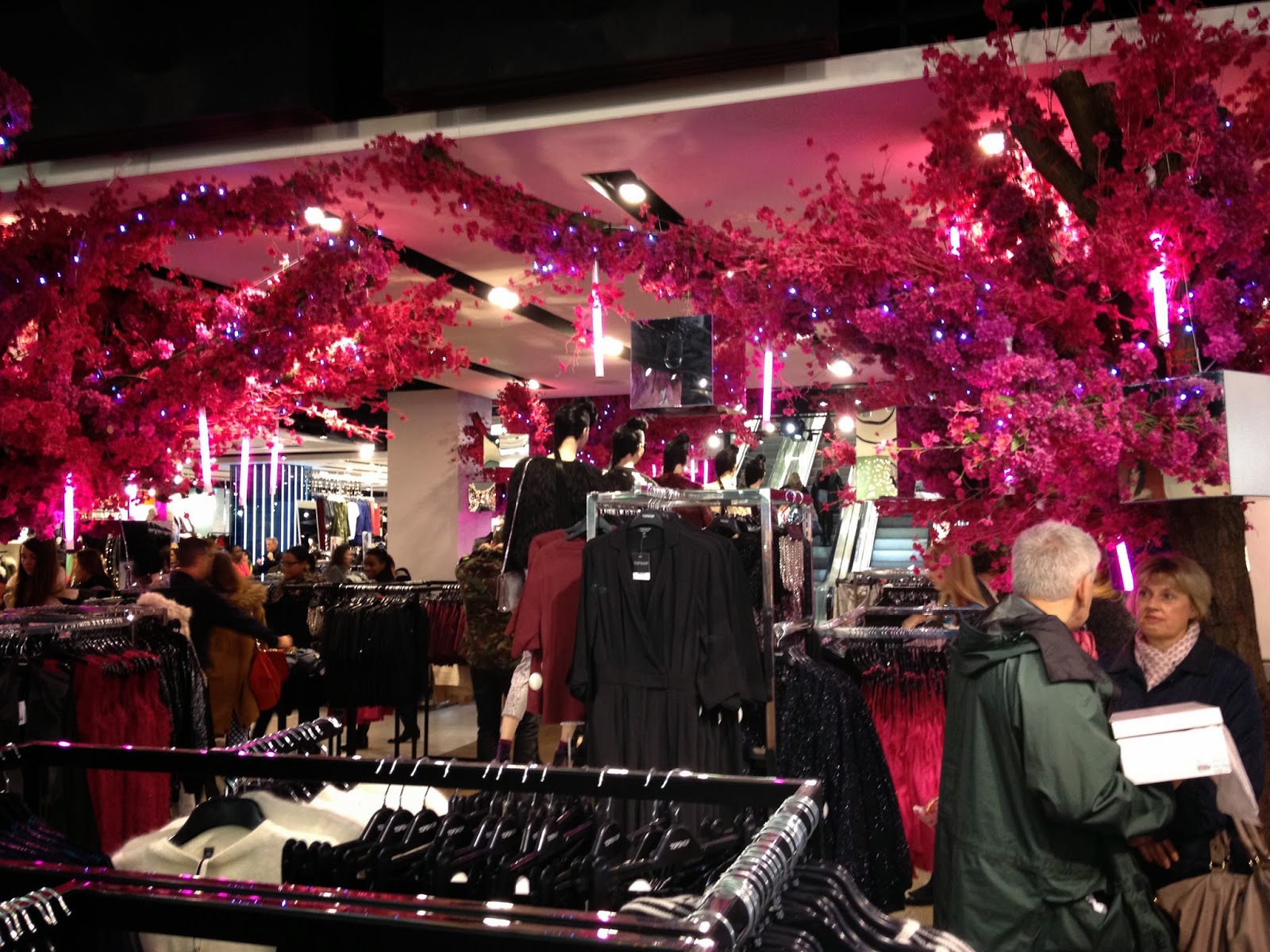
On Friday 27th November I took a trip to the capital to see Wicked the musical at the Apollo Victoria theatre. However, as this show wasn't to start until 7:30pm I saw this as a great opportunity to explore the city and do some of the activities I had on my to do list. I was to head to Hamley's toy store, in which I got off at Oxford street. However, on my travel off the tube platform onto the streets above I noticed that this day was in fact black Friday, and I was stuck in the middle at the phenomenal sale rush. This had its good points though, I wandered into Topshop, as I thought this could may be of some worth, see if I could take away anything from the famous oxford street clothing store. I cant say I took Masses away from the shop as a whole, as I was quite let down with how the store was kitted out, I expected it to be far more fancy and 'fashiony'. But saying that, there were two aspects that I found fascinating. I loved the pink trees! the colours they used, with the vibrant pink and the cute little violet lights was very cool, it stood out, and the way that the glow sticks, that too were pink lit up the trees created very nice contrasts of pink. I too loved some of the models they used, I have photographed some of these. Its not so much how they are dressed, although I love the studded mouth covering flower ear muff things (they were cool, and different) but more about how realistic they made them. the positions they held the models in to the make up and hair gave me a really crept out and eerie feel whilst walking past these, they were so creepily realistic. But also the way they made it seem as if the models were actually moving down the catwalk, they had such presence and dominance in the room.
Monday, 21 October 2013
Extended Research: Africans in the Renaissance
After Toby Warner's seminar I thought that I would have a go at researching black Africans in Renaissance art to see if it was as easy to find material as he stated so. And as a matter of fact, it was extremely so, if not even easier! So as I searched through the countless images I thought I should gather a small selection of the works to reference to Warner's seminar that I wrote about previously.
If you were to do the same as I, and research this stunning but also boggling subject I would have to recommend visiting The Walters Art Museum's website. This is down to the fact that this Baltimore museum held an exhibition specific to this subject. From October 14, 2012–January 21, 2013 the Walters Art Museum opened the 'Revealing the African Presence in Renaissance Europe' exhibition which was dedicated to exactly as it says on the tin. This exhibition is doing proud the points that Warner was making early in his seminar, that peoples of black African ethnicity, although feature quite heavily in the works of the 1400/1500's, are not shown openly, leaving them out of the history books, and out of the class room altogether. This website and exhibition do a fantastic job at highlighting the importance of different ethnicity in everyday life but also within art.
‘Creative industries seminar’
With Toby Warner
Black history walks London
This seminar was not at all boring, far
from it actually. Full to the brim of information unheard and unseen before
with an extremely confident, comfortable and charming speaker meant that I
found myself wanting to be sat there listening. With my ears opened wide to
every word spoken I didn’t feel as if time was at all wasted, which is the norm
for me when sitting through two hour seminars.
In the two hours Warner spoke about the
portrayal of black peoples in the media and other Medias and did a marvellous
job at gauging my attention by specifically focusing on my subject specialism
of art, which I was very thankful for.
He began his lecture by introducing a series of images ‘found on Google’
that spanned back throughout history. These pieces of timed artworks depicted
men and women of black ethnicity in highly regarded and respected positions
such as saints and priests., which dated back as early as the 1400’s.
Such
artwork being unknown to me, this was mind blowing but also rather shocking and
upsetting at the same time. It was horrible to think that these images had been
held back from being shown to us as we grew up, for no arguable reason. Even
now, as I am completing my further college year, nearing higher education and
university, I still see a lack of if not any images such as those I was shown
sitting in Warners seminar.
Warner did a momentous job of opening my eyes to the racial unjust and racism that we today live in. I shall use such thoughts that Warner provoked and helped create inside me not only within my practice, helping it grow that extra layer, but also in my day by day life and how I look at things.
I
would say if you ever had a chance as to watch one of Warners lectures or
partake in one of his walks or shows then definitely take that chance, with
both hands, because honestly, it will totally change the way you see things. It
did for me.
Friday, 18 October 2013
Contextual Horizons Research: HAMLEYS
Hamleys Toy Shop...
| http://www.hamleys.com/ |
Contextual Horizons Research: 'Subversive Design'
Sebastian Brajkovic, Lathe v Red, 2008.
Courtesy Carpenters Workshop Gallery
|
My third activity I have chosen to visit is the ‘Subversive
Design’ exhibition being held at the Brighton Museum and art gallery from 12 October
2013 to 9th march 2014.
As an exhibition that ‘subverts your preconceptions and
challenges your relationship with objects you use on a daily basis’ I think
that this is an opportunity that I would kick myself over if lost. It’s a
perfect chance to see how these designers and artists have thought ‘outside the
box’ to create the artwork on show which can only help me progress in my own
practice. A personal target for myself is to always try and push, if not, break
the boundaries, to extend past what is expected and I think this Exhibition is
a superb way of aiding me in this challenge. I am excited to see how exactly
the designers and craftsmen
on show, such as Alexander McQueen, have tackled the idea of changing perceptions and preconceptions,
taking the everyday and manipulating it in such a way.
I am very giddy about
this one, I haven’t really much idea of what things are going to be like, and I
have never really focused in on design and craftsmen element of art yet before,
so this too will be a great way of expanding my subject area knowledge which
will only do me justice.
The admission cost
for this exhibition is a modest £6 for adults, concession and disabled £4, B&H
residents being free and children under the age of 15 go free.
I shall report back
with thoughts, reflections and a review of the exhibition once visited.
I am quite
buzzing :)
Thursday, 17 October 2013
Contextual Horizons research: 'Between Dimensions'- John Carter RA
The next
Activities I wish to complete for this task is to visit the ‘Between Dimensions’
exhibition held at the Royal Academy in London, specifically the Tenant
Gallery. This exhibition held by the RA is showing the works of RA John Carter.
The reason in which I chose to visit this exhibition especially was not just
because of the works of Carter but because it is showing the transformation and
journey his work undergoes, from ideas to sketchbooks to the final finished piece.
I think this will allow me to see firsthand at how a professional working artist
reflects on his work and how he develops these reflections. This will help me
gain vital experience which will allow me to better my practice using and
improving my own reflections, as it is a target of mine at college.
http://www.royalacademy.org.uk/exhibitions/the-tennant-gallery/john-carter-ra-between-dimensions,480,RAL.html
This exhibition is to be held at the Royal Academy in London
from, the 2nd October 2013 to the 16th February 2014.
Opening times:
Tuesday–Friday, 10 am–4 pm
Saturday and Sunday, 10am–6pm
| John Carter RA, 'Matrix', 2012. Oil on cut paper , 475 x 475 mm. © the artist. Photo: Peter Abrahams, Lucid Plane |
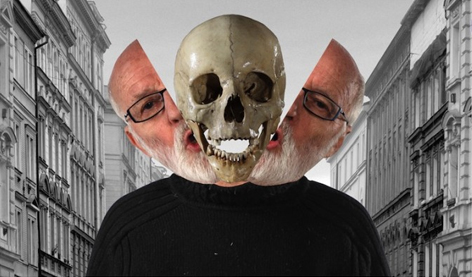
Contextual Horizons Research: 'Inner life of objects'- Jan Svakmajer
The first of my 5 activities I researched and
chose is the ‘inner life of objects’ by
Surrealist film artists Jan Svankmajer. This galley is to be held at the Brighton
Universities Sallis
Benney Theatre and University Gallery in celebration of Svankmajers marvelous 50 year career in the business
since his first ever film. The Gallery is open from 11/10/13- 2/12/13, Mon-Fri
11am-7pm ,Sat 10am-5pm. This show, being a celebration of his 50th
anniversary will be displaying “sets and decors, puppets, costumes, drawings and storyboards from many of
his acclaimed films including Alice, Punch and Judy, Lunacy, A Quiet Week in
the House, Little Otik and Surviving Life”. “Alongside these artifacts
from 50 years of film-making, THE INNER LIFE OF OBJECTS presents prints and
sculptures – including imaginary beasts assembled from bones, shells and stones
– in his Historia Naturae series, made by Jan Švankmajer between 1972 and 2012”.
http://www.youtube.com/watch?v=DRe6nnoaGEY
Subscribe to:
Posts (Atom)